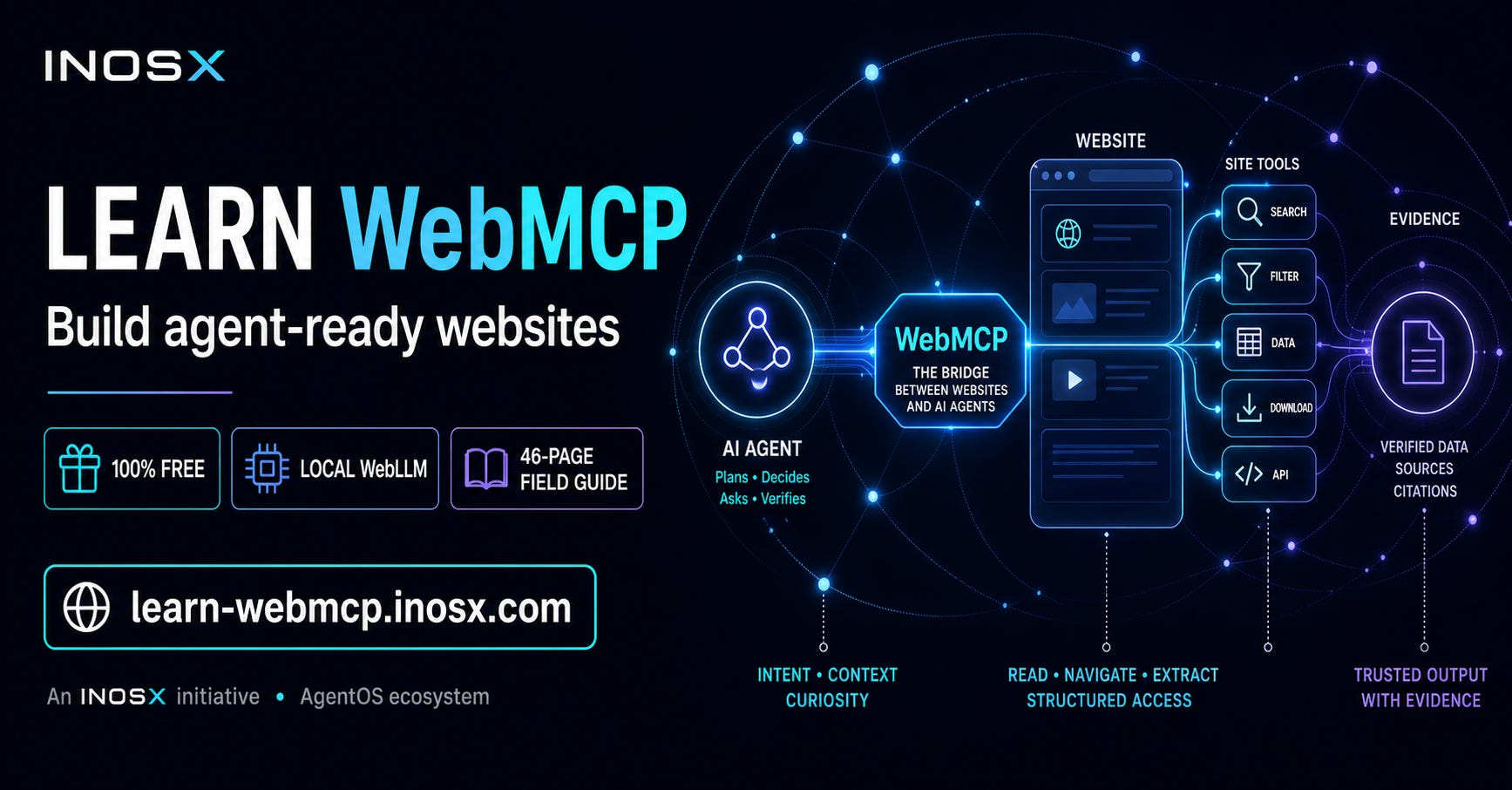
On August 25, OpenAI introduced Site tools, its implementation of the proposed WebMCP standard. Instead of forcing an agent to interpret every button and field visually, a website can expose structured actions the agent can discover and use directly on the live page and within the user’s session.
Reading that definition is one thing. Seeing it work is another.
That is why we built the INOSX WebMCP Agent Lab: a bilingual, 100% free, guided experience where you can learn the concept, prepare an agent, execute tools, and inspect the trace of every action.
Inside the lab, you will find:
→ browser and environment compatibility checks
→ a self-guided journey from concept to execution
→ an on-device local WebLLM demonstration
→ examples of discovery, schemas, read/write tools, and human control
→ real code for registering a WebMCP tool
→ a 46-page Field Guide in English and Portuguese, available after registration
You do not need ChatGPT to get started. The lab provides a local WebLLM to demonstrate the agent → tool → result journey. In compatible environments, ChatGPT or Codex can also act as the agent.
This is hands-on learning: enter the lab, experiment, and understand how agent-ready websites can connect human interfaces, AI agents, and governance.
The initiative also explores a central question for AI First companies: how can agents enter real workflows without losing context, control, or evidence?
One practical note: the page checks what works in each environment. To use Site tools with ChatGPT, open the lab in the ChatGPT desktop app’s built-in browser.
Visit:
https://learn-webmcp.inosx.com/
Explore it. Test it. Download the guide.
Then tell me: what capability would you want an agent to execute safely on your website?
From the lab to real operations: meet INOSX AgentOS, the ecosystem we are building to coordinate agents, context, tools, and human oversight.
#WebMCP #AIAgents #AIFirst #INOSX #AgentOS


